A) dividends.
B) the expected final sale price.
C) the ability of the corporation to earn profits.
D) All of the above are correct.
F) A) and B)
Correct Answer

verified
Correct Answer
verified
A) the risk associated with selecting stocks in only a few specific companies
B) the risk that a person will become overconfident in his ability to select stocks
C) a high-risk person being more likely to apply for insurance
D) after obtaining insurance a person having less incentive to be careful
F) A) and C)
Correct Answer
verified
Correct Answer
verified
A) 5.50 percent
B) 5.65 percent
C) 6.25 percent
D) 7.05 percent
F) A) and C)
Correct Answer
verified
Correct Answer
verified
A) Option A
B) Option B
C) Option C
D) The answer depends on the rate of interest, which is not specified here.
F) A) and B)
Correct Answer
verified
Correct Answer
verified
A) a game where she has a 70 percent chance of winning $1 and a 30 percent chance of losing $1
B) a game where she has a 60 percent chance of winning $100 and a 40 percent chance of losing $100
C) a game where she has a 60 percent chance of winning $2 and a 40 percent chance of losing $1
D) All of the above are correct.
F) B) and D)
Correct Answer
verified
Correct Answer
verified
A) stock prices are driven by investors' "animal spirits."
B) the random-walk theory of stock prices is incorrect.
C) the efficient markets hypothesis is correct.
D) actively managed mutual funds always outperform index funds.
F) A) and C)
Correct Answer
verified
Correct Answer
verified
A) $540.75
B) $540.80
C) $540.85
D) None of the above are correct to the nearest cent.
F) All of the above
Correct Answer
verified
Correct Answer
verified
A) raise the present value and the price of the corporation's stock.
B) raise the present value and reduce the price of the corporation's stock.
C) reduce the present value and the price of the corporation's stock.
D) reduce the present value and raise the price of the corporation's stock.
F) A) and C)
Correct Answer
verified
Correct Answer
verified
A) are the rates of return on mutual funds.
B) are cash payments that companies make to shareholders.
C) are the difference between the price and present value per share of a stock.
D) are the rates of return on a company's capital stock.
F) A) and B)
Correct Answer
verified
Correct Answer
verified
B) False
Correct Answer
verified
Correct Answer
verified
A) $240 paid in three years
B) $225 paid in two years
C) $210 paid in one year
D) $200 today
F) None of the above
Correct Answer
verified
Correct Answer
verified
If you put $400 into a bank account today and it promises to pay 5% interest for 6 years, how much is in the account at the end of the six years? 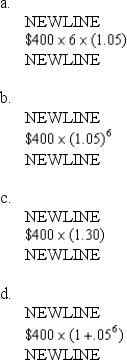
) undefined
Correct Answer
verified
Correct Answer
verified
A) finding the present value of a future sum of money.
B) finding the future value of a present sum of money.
C) changes in the interest rate over time on a bank account or a similar savings vehicle.
D) interest being earned on previously-earned interest.
F) A) and D)
Correct Answer
verified
Correct Answer
verified
A) If Jill puts $5,000 today into a bank account that pays 3 percent interest, then how much will she have in the account after 2 years?
B) Should ABC Corporation buy a factory today for $2 million, knowing that the factory will yield the corporation $3 million after 5 years?
C) As the winner of a lottery, should Michael choose an immediate payment of $250,000 or should he choose annual payments of $30,000 for each of the next 10 years?
D) You would find it necessary to calculate a future value in order to answer all of these questions.
F) A) and D)
Correct Answer
verified
Correct Answer
verified
A) 4.5 percent
B) 5.4 percent
C) 6.2 percent
D) 8.0 percent
F) B) and C)
Correct Answer
verified
Correct Answer
verified
A) option A.
B) option B.
C) option C.
D) either A or B because they are the same to her.
F) A) and B)
Correct Answer
verified
Correct Answer
verified
A) 7 percent
B) 8 percent
C) 9 percent
D) 10 percent
F) B) and C)
Correct Answer
verified
Correct Answer
verified
A) increases the standard deviation of the value of a portfolio indicating its risk has increased.
B) increases the standard deviation of the value of a portfolio indicating its risk has decreased.
C) decreases the standard deviation of the value of a portfolio indicating its risk has increased.
D) decreases the standard deviation of the value of a portfolio indicating its risk has decreased.
F) B) and D)
Correct Answer
verified
Correct Answer
verified
A) increasing marginal utility of wealth and is risk averse.
B) increasing marginal utility of wealth and is not risk averse.
C) decreasing marginal utility of wealth and is risk averse.
D) decreasing marginal utility of wealth and is not risk averse.
F) A) and B)
Correct Answer
verified
Correct Answer
verified
A) Simpson announces, just as everyone had expected, that it has hired a new highly respected CEO.
B) Simpson announces that its profits were low, but not as low as the market had expected.
C) Analysis by a column in a business weekly indicates that Simpson is overvalued.
D) All of the above would increase the price.
F) B) and C)
Correct Answer
verified
Correct Answer
verified
Showing 361 - 380 of 500
Related Exams